


On July 13, the State Council officially approved the "15th Five-Year Plan for Expanding Consumption," setting a target of approximately 60 trillion yuan in total retail sales of consumer goods by 2030, with a base of 50 trillion yuan in 2025. This means creating an additional 10 trillion yuan in consumption over five years, equivalent to an average annual compound growth rate of 3.7%.
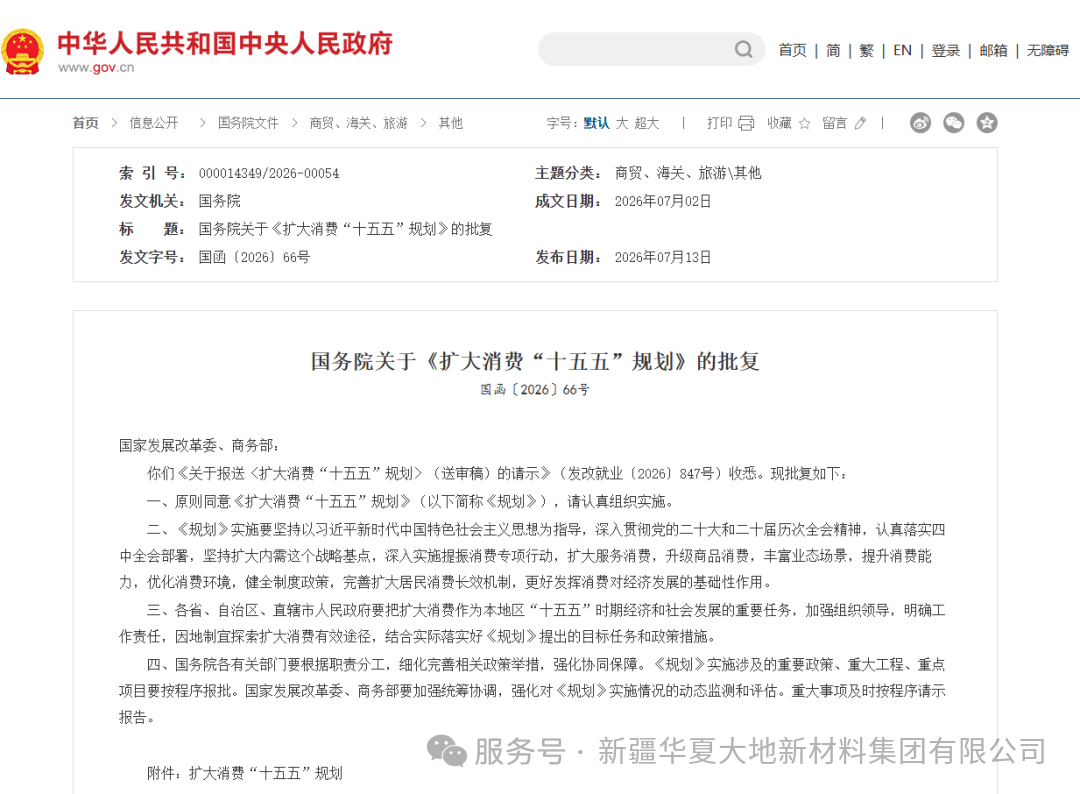
This plan consists of eight sections and 28 measures, with content related to bio-based and degradable materials appearing in section four, "Cultivating and Developing New Consumption Models, Forms, and Scenarios," under measure (13).
(13) Promote green consumption. Strengthen the production and promotion of green and low-carbon products, enrich the supply of green agricultural products, green home appliances and furnishings, green building materials, new energy vehicles, and develop green catering, green accommodation, and green household services. Build a green supply chain, improve the certification and labeling system for green products, encourage the use of environmentally friendly and biodegradable packaging materials, expand demand for renewable energy, and promote green procurement. Advance green recycling, improve the recycling system for waste home appliances and furniture, enhance the operational standards of second-hand goods markets and businesses, and regulate the development of second-hand product trading platforms. Advocate green consumption concepts and low-carbon lifestyles, and establish effective incentives for green consumption.
01 Opportunity 1: Biodegradable packaging materials, highlighted twice by national ministries within six months
In January, the Ministry of Commerce and eight other departments jointly issued the "Notice on Implementing the Green Consumption Promotion Initiative," explicitly requiring the promotion of biodegradable materials in five key sectors: catering, accommodation, logistics, home services, and retail. In July, the State Council's consumption planning reiterated the need to "guide the use of environmentally friendly, biodegradable packaging materials."
Two mentions within half a year are no coincidence. From the supply side, the market now has a clear tiered structure:
First-tier (already scaled up): Materials such as PBAT, PLA, and paper pulp molding are currently the mainstream choices for biodegradable packaging.
Second-tier (accelerated industrialization): PHA (polyhydroxyalkanoates) stands out in paper-based barrier packaging, with Microstructure Factory having completed China's first 10,000-ton production line. Companies such as CJ Bio-materials, Blue Biotech, Medif, Ningbo Tian'an, Mibei Bio, and Yikeman Bio have also entered this field. PPC (polycarbonate propylene), produced from CO₂ and propylene oxide, offers dual benefits of carbon fixation and biodegradability, with significantly superior barrier properties compared to common biodegradable materials like PLA and PBAT. In May this year, the world’s first 50,000-ton CO₂-based PPC production facility by Lianhong Green, a subsidiary of Lianhong New Materials, was successfully launched. PGA (polyglycolic acid), thanks to its excellent gas barrier performance, is rapidly penetrating high-barrier food packaging applications, with a projected market size reaching 5.55 billion yuan by 2026. PCL (polycaprolactone) is accelerating its adoption in low-temperature refrigerated food packaging films and medical films. The domestic market size reached approximately 1.488 billion yuan in 2024. Hunan Juren New Materials has already built a 55,000-ton-per-year production capacity, while Shenzhen Guanghua Weiye led the drafting of the national standard for PCL.
Third-tier (Frontier Breakthrough): PDA fully biodegradable plastic, developed by Professor Ji Junhui's team at the Institute of Physics, Chinese Academy of Sciences, can completely degrade in soil, freshwater, and marine environments without generating microplastics. The company Zhongke Kelan, which commercialized this technology, has already launched a 3,000-ton production line, is continuously fulfilling kiloton-level orders, and has initiated planning for a 30,000-ton facility. It also collaborates with Xiaomi and Lenovo to launch biodegradable packaging for 3C electronics. Meanwhile, Dr. Zhu Jin's research group from Ningbo Institute of Materials Technology took an alternative approach, using oxalic acid (approximately 3,500 yuan per ton) as raw material to develop a fully degradable oxalate copolyester. This material achieves tensile strength of 30–55 MPa and offers oxygen and water barrier properties that are 69 times and 18 times higher than those of PBAT, respectively, and has achieved kilogram-scale production in a 100-liter reactor.
According to the "2025 Global and China Biodegradable Packaging Market Analysis Report," China's biodegradable packaging industry reached a scale of 280 billion yuan in 2025, representing a year-on-year increase of 35%. Conservatively estimating based on an average annual compound growth rate of 3.7% in new consumption volume, the degradable packaging industry is expected to grow by over 10 billion yuan annually, while the market size for degradable packaging materials alone is projected to reach tens of billions of yuan.
02 Opportunity Two: Renewable Energy, Now Included in National Mandatory Assessments
The plan proposes "expanding the demand for renewable energy consumption," a provision placed within the consumption planning section that may easily be overlooked, yet sends a clear signal.
On June 22, less than a month ago, the National Development and Reform Commission and three other ministries jointly issued the "Implementation Measures for the Minimum Proportion Target of Renewable Energy Consumption and the Responsibility Weight System for Renewable Power Consumption," marking the first time that non-electrical consumption of renewable energy such as biofuels has been included in national mandatory assessment. On June 25, the National Development and Reform Commission and the National Energy Administration jointly released the "15th Five-Year Plan for Building a New Energy System," clearly stating: "Develop green fuel production capacity—such as non-grain bioethanol, biodiesel, biomethane, sustainable aviation fuels, green ammonia, and green methanol—in accordance with local conditions."
Three documents, from different angles, form a policy encirclement.
Bioethanol, biodiesel, sustainable aviation fuel (SAF), and biomethane—these categories already have an industrial foundation in China. As of the first quarter of 2026, the country has established an annual SAF production capacity of approximately 1.7 million tons. According to a joint response from four ministries to reporters, key energy-consuming sectors will focus on industries, construction, and transportation. With the top-level guidance now set to "expand renewable energy consumption demand" at the consumer end, the transmission of green premiums on the demand side will become smoother.
03 Opportunity Three: 3D Printing Materials, with PLA Taking the Lead
Article (12) of the "Plan," titled "Developing Digital Consumption," proposes "increasing the effective supply of next-generation smart terminal products such as desktop 3D printers."
This material does not appear in the green consumption section, but is closely related to bio-based materials—polylactic acid (PLA) is the mainstream material for consumer-grade 3D printing filaments.
In Q1 2026, China's 3D printer exports increased by 118% year-on-year in value and by 86% in volume. In 2025, Haizheng Bio-Materials' business in the 3D printing sector grew by 88.6% year-on-year, and in 2026, the main growth will come from this sector, with an expected increase of around 50%. The 3D printing industry is growing at a very rapid pace. Based on current shipments of 3D printing equipment and existing installed base, industry estimates suggest that total polylactic acid (PLA) consumption in the 3D printing sector could reach 120,000 to 140,000 tons in 2026.
3D printing materials represent a structural growth driver for PLA in the consumer electronics sector.
The story of a 10-trillion-yuan increase in consumption is just beginning. Both green consumption and digital consumption offer opportunities for bio-based materials. For companies, the next question isn't whether policies are good or not, but which materials can meet this wave of demand.