

A transparent food container holds a salad, pastries, or takeout. It may stay in the consumer’s hands for only half an hour.
But things get complicated once the box is emptied.
When people talk about PLA, they often start by asking: “How long does it take to degrade?” That question isn’t wrong—but it skips over a more practical one: where will it ultimately end up?
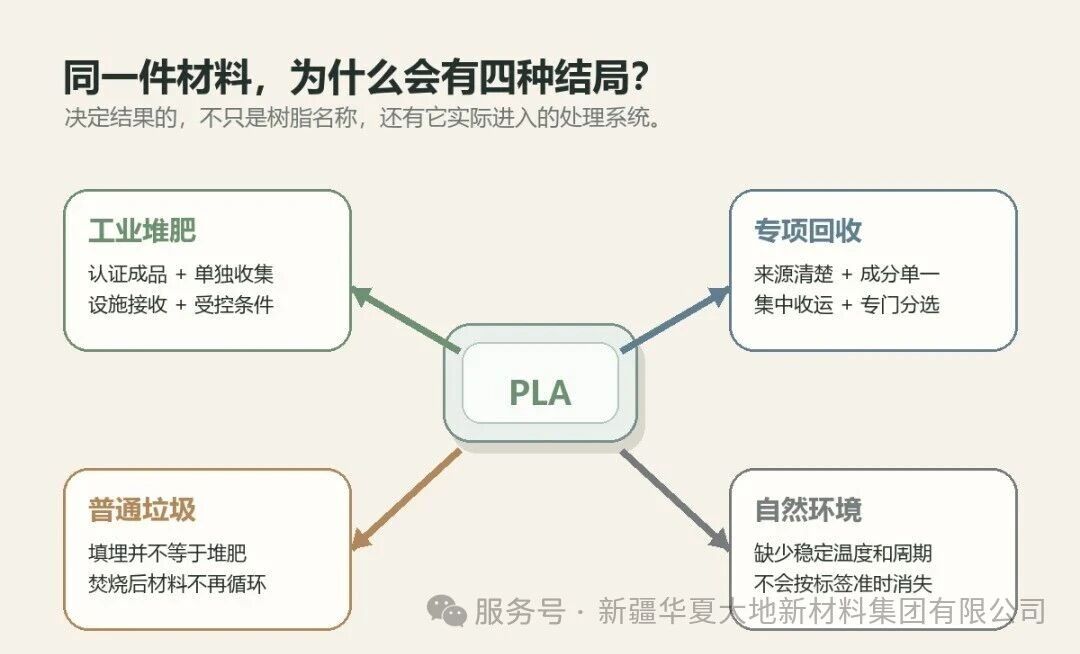
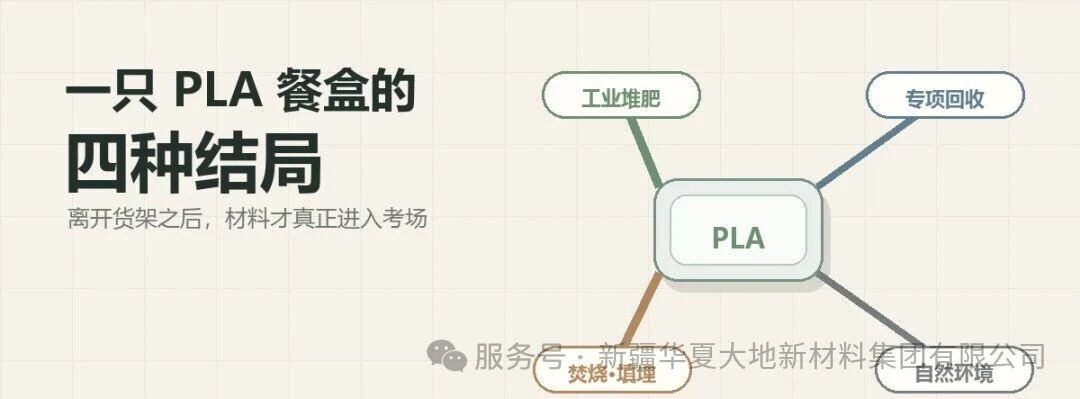
The same PLA container, after leaving the shelf, could follow four entirely different paths.
First outcome: Industrial composting
This is the path most commonly featured in marketing materials—and also the one with the most requirements.
For a PLA product to enter industrial composting, several conditions must be met: the item must comply with relevant compostability standards, be separately collected after use, have access to local facilities that accept such materials, and undergo processing under appropriate temperature, humidity, oxygen supply, and time.
The word "industrial" cannot be omitted. The European Commission emphasizes that compostable plastics typically break down in industrial composting facilities—and only if properly sorted first.
This route works best for short-term items contaminated with food, which are costly to clean and recycle—such as meal containers, cups, and organic waste bags used in specific settings. The key is that these items can be integrated into the treatment chain alongside food scraps.
If a city lacks the proper sorting and processing capacity, a container labeled “compostable” won’t automatically find its way to a compost facility.
Second outcome: Specialized recycling
PLA doesn’t have to wait for degradation. If the material is relatively pure, minimally contaminated, and available in sufficient volume, it can also enter mechanical or chemical recycling streams.
The challenge lies in the word “specialized.”
In practice, recycling systems usually prioritize high-volume, stable-value, and easily identifiable materials. Small amounts of PLA mixed into conventional plastic streams like PET or PP might not be accurately sorted, potentially complicating processing instead.
Thus, PLA recycling suits closed or semi-closed environments—such as campuses, exhibitions, schools, or restaurants—where usage and collection points are close, sources are clear, and dedicated teams manage centralized collection.
“Technically recyclable” is not the same as “recyclable just by tossing it into any recycling bin today.”
Third outcome: Mixed municipal waste
Without separate collection, most consumers’ only option is to throw the container into the existing general waste stream.
Once buried in landfills, PLA rarely receives the heat, oxygen, and moisture required for industrial composting. NatureWorks itself notes in its material lifecycle documentation that landfill conditions do not support efficient decomposition.
Entering incineration systems may recover some energy, but the material itself won’t re-enter the circular economy.
This path sounds less than ideal, yet it highlights a crucial fact: a material’s real-world performance depends heavily on local waste management infrastructure. Without considering actual urban, campus, or corporate processing capabilities, comparing materials solely by name leads to misleading conclusions.
Fourth outcome: Into soil, rivers, or oceans
This is the path we hope never happens—but one we can’t ignore.
Natural environments aren’t large-scale composting facilities. Temperature, microbes, oxygen, and moisture levels vary widely along roadsides, in soil, rivers, and oceans, and there’s no consistent processing cycle.
The United Nations Environment Programme has long warned that conditions suitable for full biodegradation are rare in marine environments; certain polymers require industrial facilities and sustained high temperatures to break down.
Therefore, “degradable” should not mean “it’s okay to litter.” Once in nature, PLA won’t disappear promptly just because of a label.
The real choice happens before production After examining these four outcomes, you'll realize that the PLA's toughest challenge isn't whether it can degrade, but how to reach the right processing conditions.
This question should be clarified during the product design phase:
Where will the product be used, and will it come into contact with large amounts of food after use?
What kind of trash bins are available on-site, and where will collection services take the waste?
Will end-of-life facilities accept PLA or compostable products?
Is the entire product—including inks, labels, adhesives, and coatings—compatible with this pathway?
Without answers to these four questions, simply switching to a different resin often just changes the material, not the outcome.
Conversely, if usage scenarios are well-defined, labeling is clear, collection is consistent, and end facilities are willing to accept it, PLA has the chance to deliver its true value. It’s not plastic that disappears automatically—it’s an additional option for specific treatment systems.
Writing "degradable" on a materials list completes only half the answer. The other half depends on product design, sorting and collection, and end-of-life infrastructure working together.
In your city or industrial park, how far can a PLA food container actually go?