


Polylactic acid (PLA) is currently the largest-scale industrialized, most maturely processed, and highest-compliance fully bio-based, biodegradable thermoplastic polymer material. Unlike petroleum-based degradable plastics such as PBAT, PLA is entirely derived from renewable agricultural and forestry biomass resources. It serves as a core alternative to conventional petroleum-based plastics under global plastic restriction policies and stands as a key product in the low-carbon polymer materials sector.
1. Raw Material Synthesis and Preparation Process
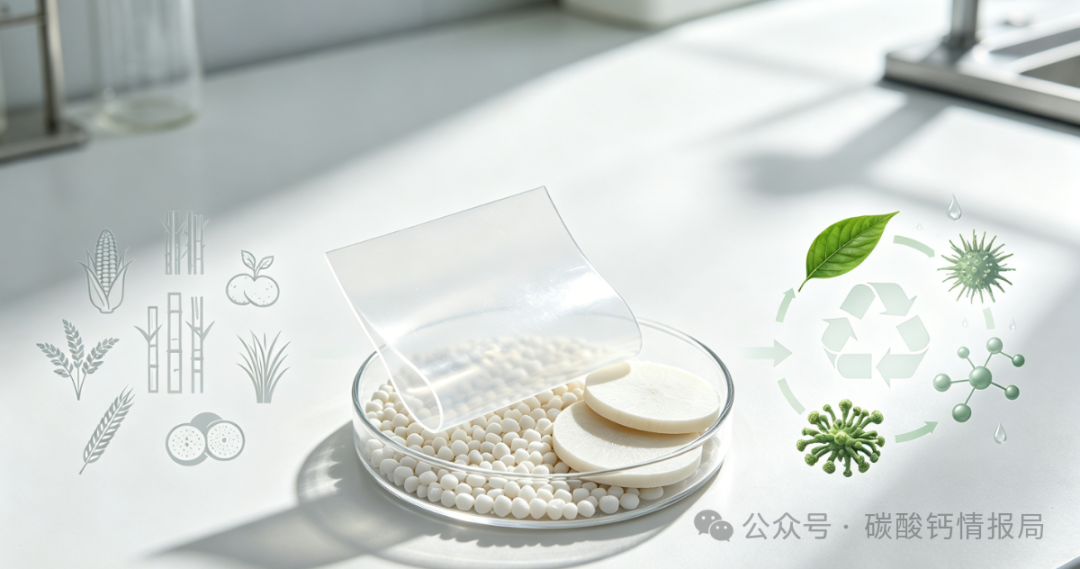
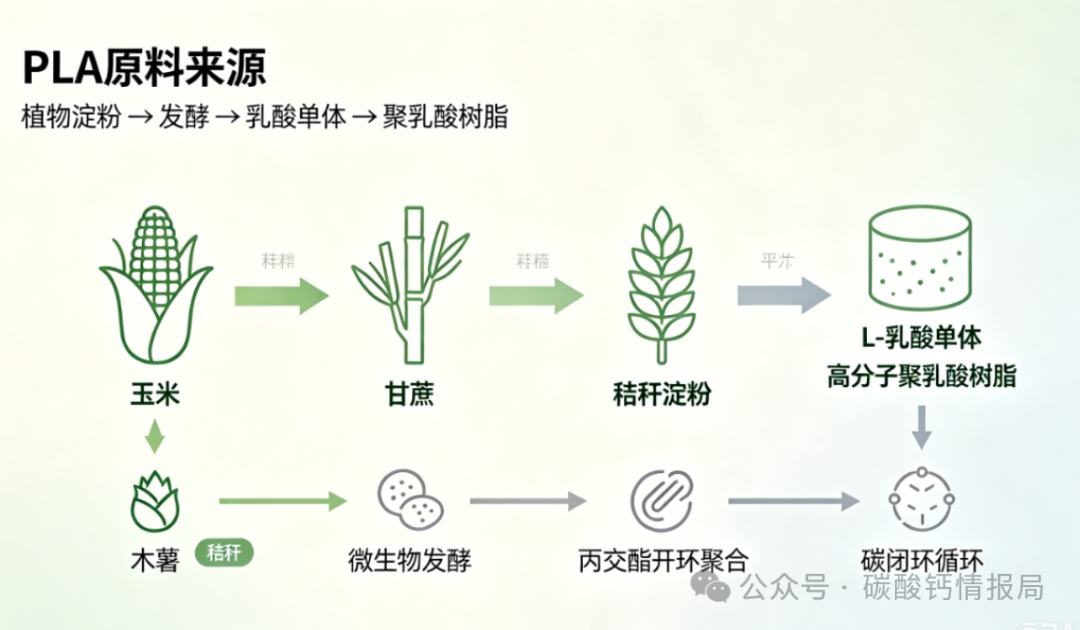
The upstream raw materials for PLA are renewable agricultural and forestry carbohydrate resources such as corn, sugarcane, cassava, and straw starch. The entire production process is independent of petrochemical feedstocks and consists of two main stages: First, through microbial anaerobic fermentation, plant starch is saccharified and purified to produce L-lactic acid monomers. Second, via two mainstream polymerization processes—direct polycondensation of lactic acid and ring-opening polymerization of lactide—high-molecular-weight polylactic acid resin is synthesized. This process achieves a closed carbon cycle throughout its lifecycle: carbon is sequestered during raw material cultivation and released back into the atmosphere upon product degradation, resulting in significantly lower carbon emissions compared to traditional plastics like PE, PP, and PET, thus meeting industrial dual-carbon management standards.
II. Core Physicochemical Properties and Mechanisms of Performance Advantages
(1) Key Performance Advantages
Closed-loop, Specific Biodegradability: PLA degradation is highly specific to environmental conditions—exhibiting exceptional stability under normal ambient temperatures and natural environments, preventing random decomposition. It only undergoes gradual hydrolysis and breakdown of ester bonds under industrial high-temperature composting (55–70°C), high humidity, and microbial-rich conditions, ultimately being fully metabolized by microorganisms into carbon dioxide and pure water. No plasticizers, microplastics, or toxic residues are released, effectively eliminating white pollution and fully complying with national and international standards for biodegradable products.
Dual Bio-safety Compatibility for Food and Medical Applications: The material is polymerized without aromatic hydrocarbons, heavy metals, or volatile harmful monomers. It has passed both Chinese national food contact material safety standards and EU FDA medical-grade certifications. With stable physicochemical properties and no skin or mucosal irritation, it can be directly in contact with fresh food and human tissues, making it one of the few polymer-based biodegradable materials suitable for actual medical implant applications.
Broad Compatibility with Thermal Processing Technologies: PLA features a stable melting range of 150–180°C, offering a wide thermal processing window compatible with all major plastic forming techniques—including injection molding, extrusion, blow film, cast film, spinning, and FDM (fused deposition modeling) 3D printing. Existing conventional plastic production equipment requires minimal modification for immediate use, resulting in low barriers to downstream industrialization.
High Rigidity and High Transparency: Due to its high molecular regularity, PLA products achieve light transmittance exceeding 90%, surpassing the transparency of conventional polypropylene (PP). Its high intrinsic bending modulus ensures excellent rigidity and resistance to deformation, enabling high flatness in molded parts—ideal for packaging applications requiring premium visual quality.
(2) Structural Shortcomings of Raw Materials
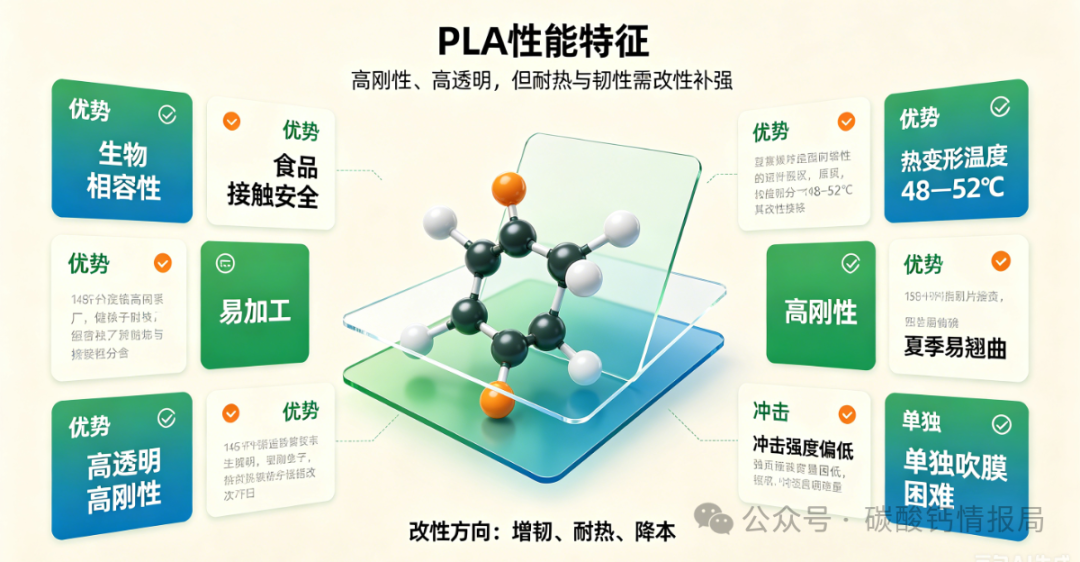
Due to the rigid structure of the molecular chain, pure native PLA has two major industrialization flaws that prevent it from directly producing general products: First, the heat resistance is insufficient, with a heat deformation temperature of only 48-52℃. It is extremely prone to softening, warping, and dimensional deformation at room temperature and in summer storage environments, and can only be used in low-temperature scenarios; Second, the toughness is extremely poor and the impact resistance is low. It is prone to cracking in low-temperature environments and has poor bending resistance; At the same time, the melt ductility is insufficient. Processing by blow molding alone is extremely difficult. The industry commonly combines activated nano calcium carbonate, modified heavy calcium carbonate, and PBAT for blending modification to enhance toughness, improve toughness, and reduce raw material costs, and adapt to production in all scenarios.
III. Segmenting the Industrialized Application Scenarios Across the Entire Territory
1. One-time packaging consumables for food
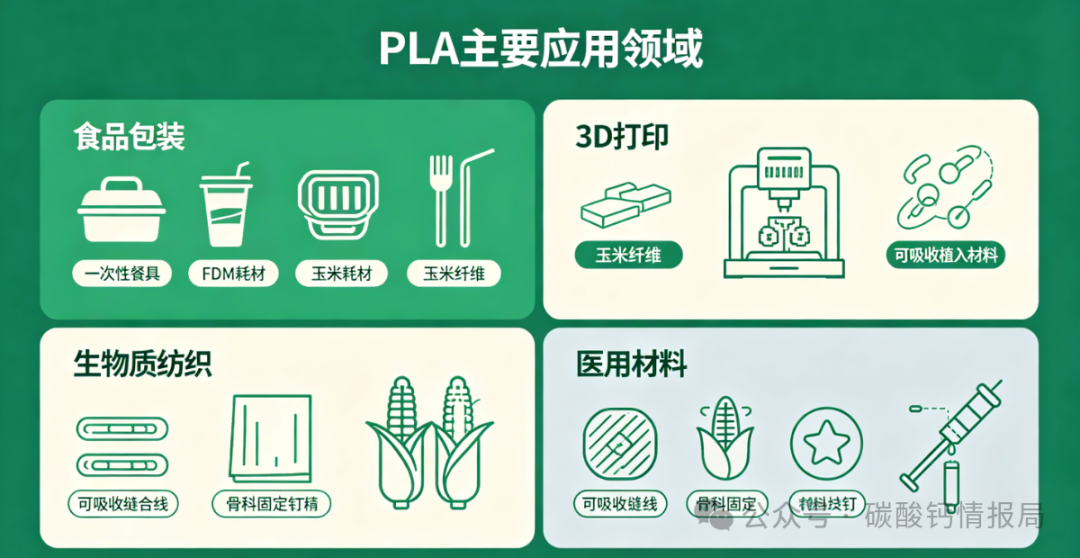
Based on the food-grade safety attributes, it can be scaled to replace PP and PS petroleum-based one-time plastics. Mass production of high-temperature-resistant modified lunch boxes, cold drink cups, food cling films, fresh produce trays, one-time biodegradable straws, knives and forks, and tableware can be achieved. These are the main compliant degradable consumables for domestic supermarkets, food delivery services, and food cold chain, and also the application field with the highest usage of calcium carbonate high-fill modification in PLA.
2. Additive Manufacturing 3D Printing Field
Standardized printing consumables for global FDM machines. Compared to ABS consumables, it has a lower processing temperature, smaller thermal shrinkage rate, stronger inter-layer adhesion of the finished product, no harmful odors during processing, high forming accuracy, and is widely used for printing of cultural and creative figurines, teaching models, industrial non-standard components, and workholding fixtures, catering to the niche high-value-added PLA market segment.
3. Biomass Functional Textile Field
Biomass corn fibers are produced through melt spinning technology. The fabric inherently possesses hydrophobic and hygroscopic properties, UV resistance, and antibacterial properties. It can be biodegraded to eliminate waste pollution from non-woven fabrics. It is specifically used in high-end outdoor sports clothing, home textiles, medical non-woven fabrics, and agricultural geotextile biodegradable non-woven fabrics. The end-of-life waste can be directly composted for degradation.
4. Implantable Medical Biomedical Materials
Relying on the native biocompatibility, no secondary extraction surgery is required. They can autonomously adapt to the temporal degradation process of the human body's fluid environment. Currently, they are maturely applied in absorbable surgical sutures, orthopedic fixation nails and plates, and drug-controlled release carriers. The degradation cycle can be precisely regulated through polymer modification, and medical compliance is irreplaceable.
IV. Industry Development
Compared with petroleum-based synthetic degradable plastic PBAT, PLA has unique advantages such as being biodegradable from nature, meeting both medical and food safety standards, and being highly transparent and rigid. It is a core material for global plastic restriction and low-carbon governance. However, its inherent performance defects prevent it from being used alone commercially. Currently, the mainstream technical routes in the industry are: PLA + activated ultra-fine calcium carbonate inorganic filler modification, and PLA/PBAT polymer blending modification. These approaches aim to balance the toughness, heat resistance, and production cost of the products, and are the core research and development directions for current calcium carbonate powder enterprises and degradation modification enterprises.