


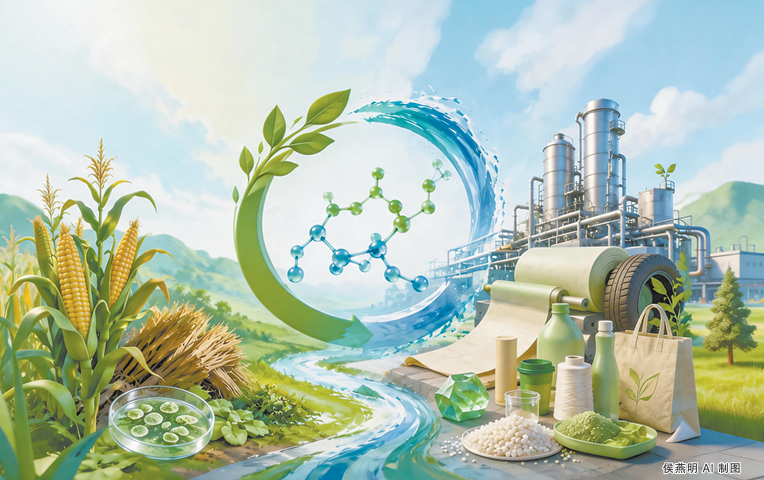
An important solution to global environmental, resource, and climate challenges is the development of bio-based materials—high-performance polymers synthesized through polymerization reactions from monomers obtained via biological or chemical conversion of renewable biomass resources such as corn, straw, and microorganisms.
A key advantage of developing bio-based materials lies in the strong compatibility with existing polymerization equipment, requiring no large-scale modifications and significantly lowering industrialization barriers. By replacing petroleum-based raw materials at the source, these materials achieve substantial carbon reduction across their entire lifecycle—for instance, producing one ton of bio-based rubber reduces CO₂ emissions by approximately 1.4 tons. Utilizing renewable biomass resources enables the establishment of an independent, controllable, and sustainable raw material system, reducing reliance on fossil fuels and enhancing supply chain resilience and resource security. Furthermore, this fosters the emergence of high-performance bio-based new materials and technologies, driving green and low-carbon transformation in traditional materials industries and reshaping the competitive landscape.
Bio-based does not equal biodegradable; some bio-based materials are non-degradable, while some petroleum-based materials are degradable. The core of developing bio-based materials lies in gradually replacing traditional petrochemical monomers with renewable and recyclable bio-based monomers. This is not only a technical approach to addressing environmental issues but also a strategic choice concerning national energy security.
01 Current Status of the Three Major Bio-based Materials Industries and Technologies
● Bio-based synthetic resins have a clear global landscape, with China rapidly catching up. Bio-based new polyester PEF, thanks to its excellent performance, has emerged as a future hotspot.
● Bio-based synthetic rubber has achieved industrial-scale production breakthroughs at the ten-thousand-ton level, with non-food-based feedstocks and green certification being key factors.
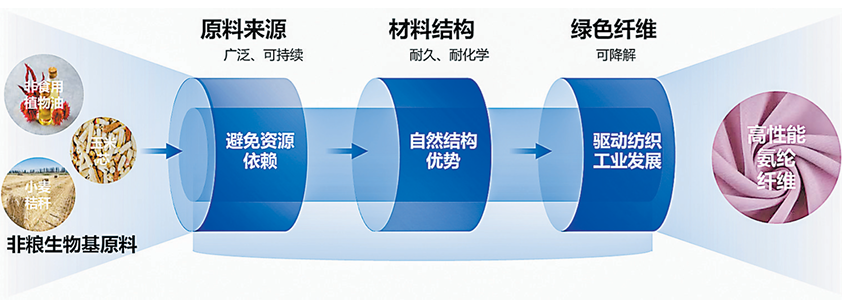
● Bio-based synthetic fibers, with China leading the world in production capacity, offer a wide range of varieties and expand into high-end application scenarios.
In the field of bio-based synthetic resins, the United States leads as the first-tier player, dominating the global PLA (polylactic acid) market with NatureWorks serving as a benchmark, establishing strong barriers in terms of production capacity and patents. Europe ranks second, excelling in bio-based PA (polyamide), PC (polycarbonate), and PET (polyethylene terephthalate), focusing on combining high performance with green manufacturing processes. The third tier consists of emerging economies led by China, which has seen rapid industrial growth. Through technology introduction and independent R&D, it has already developed international competitiveness in certain segments of PLA and bio-based polyesters.
Among bio-based synthetic resins, biodegradable types include PLA, PHA (polyhydroxyalkanoates), and PBS (polybutylene succinate), which are used in food packaging, tableware, and express delivery bags. Non-biodegradable varieties such as bio-based PET, PA, and PE (polyethylene) are applied in textiles, automotive interiors, electronics, and other fields. PEF (polyethylene furandicarboxylate), a novel bio-based polyester, stands out due to its excellent gas barrier properties—its ability to block carbon dioxide and oxygen far surpasses that of conventional PET—making it a highly promising next-generation material for food and beverage packaging.
In 2024, China's total production of bio-based synthetic resins exceeded 3 million tons, with a market size reaching 31 billion yuan—more than doubling since 2014. In terms of raw materials, the industry has transitioned to non-food sources, and second-generation technologies using straw and lignocellulosic biomass have overcome cost barriers, avoiding competition with food crops. Regarding processes, microbial fermentation for producing propylene glycol, succinic acid, and other compounds has matured, laying the foundation for large-scale production. However, challenges remain: first, the self-reliance rate of core microbial strains needs improvement; second, production costs are still relatively high.
In the field of bio-based synthetic rubber, in November 2024, Jingbo Zhongju's 10,000-ton-per-year non-food-crop bio-based itaconate ester rubber production line was approved for construction. This marks the entry of non-food-crop bio-based rubber products into large-scale industrialization at the ten-thousand-ton level, validating the technical and economic feasibility of non-food-crop feedstock routes and enhancing China's international competitiveness in the bio-based elastomer sector. The technology uses low-cost agricultural waste—corn cobs—as raw material and employs microbial fermentation to synthesize the product, ensuring a fully green and low-carbon process with no harmful byproducts. The product contains 20% to 100% bio-based carbon content, reducing carbon dioxide emissions by approximately 1.4 tons per ton compared to traditional petroleum-based synthetic rubber. The project has already obtained ISCC PLUS certification—a voluntary certification program under the International Sustainability & Carbon Certification (ISCC) system—securing access to a global high-end supply chain green channel and meeting European Union environmental requirements.
Transfar Synthetic Materials is the first domestic producer of bio-based butadiene rubber, certified under ISCC PLUS. By 2025, the carbon intensity per unit of butadiene rubber will be reduced by more than 10% compared to 2024.
Currently, bio-based synthetic rubber in China has replaced traditional petrochemical rubber in high-end footwear materials, protective gloves, and tire manufacturing. The industry is focusing on breakthroughs in applying bio-based rubber to green, high-performance tires, opening up new pathways for natural rubber substitution and leading the world in dandelion rubber research and development, thereby providing enterprises with diverse raw material options.
In the field of bio-based synthetic fibers, as the world's largest producer of chemical fibers, China produced 77.93 million tons of chemical fibers in 2025, creating substantial room for substitution by bio-based synthetic fibers. In 2025, China's output of bio-based synthetic fibers exceeded 900,000 tons—surpassing the United States' 220,000 tons and Europe's 160,000 tons—solidifying its global leadership position.
More than 20 types of commercialized and near-commercialized bio-based synthetic fibers have been developed, including approximately 280,000 tons per year of global PLA fiber production, around 170,000 tons per year of bio-based PET fiber, and about 80,000 tons per year of bio-based polyamide fiber (PA56). The packaging sector is the largest application market for bio-based fibers, followed by textiles, while high-end manufacturing industries are rapidly expanding their use cases.
The core technology of bio-based synthetic fibers lies in replacing petrochemical monomers with bio-based monomers. For example, bio-based PET uses bio-based ethylene glycol instead of traditional petroleum-based ethylene glycol, enabling a green transition in raw materials. The advantages include no need for large-scale modifications to existing facilities, as equipment can be directly adapted, reducing conversion costs. Moreover, leveraging mature production systems lowers initial investment and accelerates industrialization.
02 Policy and Standards Framework for Bio-based Materials
Developed economies such as those in Europe, the United States, and Japan continue to lead the global development of bio-based materials through forward-looking strategic planning and well-established policy incentive mechanisms.
China has included bio-based materials in its national strategic emerging industries and has introduced a series of supportive policies to promote large-scale, high-quality development of the industry.
International certifications such as ISCC PLUS are crucial for products entering the European and American markets, and a unified mutual recognition system is essential to overcoming global trade barriers.
The European Union has clearly stated in its "Plastics Strategy for a Circular Economy" that all plastic packaging must be recyclable or reusable by 2030. The Single-Use Plastics Directive legislatively restricts certain product categories, accelerating the transition to alternatives. In 2026, the EU's Carbon Border Adjustment Mechanism (CBAM) will extend to chemical products, imposing additional tariffs on high-carbon-footprint goods and raising entry barriers.
In 2022, the United States launched the National Biotechnology and BioManufacturing Initiative, with the federal government investing $2 billion to support research, innovation, and commercialization in cutting-edge fields such as bio-based materials and biomass energy. The U.S. Department of Agriculture's BioPreferred Program mandates federal preference for purchasing bio-based products, creating a stable and substantial initial market demand. The ASTM D6866 carbon-14 testing standard implemented by the U.S. provides a scientifically consistent basis for product market access.
Japan has established and maintained a leading position in the global bio-based materials sector, leveraging its long-standing technological expertise and market foundation in the research, development, and manufacturing of biodegradable plastics. By releasing and implementing the "Bio-Based Materials Strategic Roadmap," Japan has clearly defined the technological pathways and phased objectives for industry development, guiding coordinated collaboration across the upstream and downstream supply chain.
China has included bio-based materials in its national strategic emerging industries, actively introducing supportive policies to promote large-scale, high-quality development of the sector. The country's 15th Five-Year Plan explicitly identifies bio-based materials as a key area for breakthroughs in advanced new materials, placing them alongside quantum technology and brain-computer interfaces as future growth drivers.
In global standards for bio-based materials, the European Union emphasizes life cycle environmental impact and carbon footprint, the United States focuses on bio-based content and technical compliance, while China prioritizes raw material and industrial chain autonomy and security. ISCC PLUS certification is a prerequisite for bio-based materials entering the global supply chain. Leading domestic enterprises such as Jingbo Zhongju and Transfar Synthetic have already obtained certification, qualifying them for access to international markets.
03 Trends in the Development of Bio-based Materials
● Raw material trend: Non-grain-based materials are an inevitable direction, and carbon dioxide utilization represents the ultimate path for raw material supply.
● Technological Transformation: The deep integration of synthetic biology and AI is reshaping research, development, and production in biomanufacturing.
● Product evolution: Bio-based materials are transitioning from "alternatives" to "preferred materials."
Trend one is the transformation of raw material systems, shifting from "competing with humans for food" to "turning waste into treasure." China's bio-based materials have moved beyond reliance on food crops, transitioning toward second- and third-generation non-food biomass feedstocks. Second-generation materials include agricultural and forestry residues such as straw, corn cobs, forest byproducts, and high-energy herbaceous plants. Third-generation feedstocks are intended for future bio-manufacturing applications, including microalgae, syngas, and industrial exhaust gases.
The future direction involves using carbon dioxide from industrial or atmospheric sources as a carbon feedstock, coupled with green hydrogen, to establish entirely new biosynthetic pathways—from "biomass carbon" to "atmospheric carbon"—overcoming resource constraints and building a "carbon circular economy," with the ultimate goal of achieving a closed-loop cycle of "atmospheric carbon."
The second trend is technological pathway innovation driven by synthetic biology. This shift from traditional empiricism to a rational design paradigm powered by synthetic biology is reshaping the fundamental logic of bio-based manufacturing. By editing microbial chassis through gene editing, optimizing conversion pathways via metabolic reconstruction, and enhancing catalytic efficiency through enzyme evolution, natural limitations are being overcome to achieve precise, targeted transformation of biomass feedstocks into high-value-added chemical monomers.
The integration of artificial intelligence (AI) and biotechnology (BT) will reshape the research and development paradigm. By leveraging algorithms to accurately predict enzyme catalytic efficiency and rapidly optimize metabolic pathways, the traditionally lengthy cycle of strain iteration is significantly shortened. Combining advanced process analytical technology (PAT) with AI-based closed-loop control enables real-time monitoring and dynamic adjustment of fermentation parameters, thereby enhancing production efficiency. In the future, bio-manufacturing will shorten the "R&D-to-production" translation cycle, substantially reducing R&D costs and trial-and-error risks. Through the establishment of a data-driven rational design system, it will support products in achieving the goal of "design-on-demand, success-at-first-attempt," realizing the vision of "design equals delivery."
The third trend is a leap in product performance, evolving from "replacement" to "surpassing"—from merely functional to highly effective and ultimately superior. The first pathway involves nano-composites, incorporating nanomaterials to construct micro-nano structures that enhance strength and impact resistance. The second pathway is copolymer modification, where monomer copolymerization disrupts chain regularity, eliminating the drawbacks of brittleness and poor toughness. The third pathway is stereo-complexation, utilizing sc-PLA (stereo-complex polylactic acid) technology to form unique crystalline structures, significantly improving heat deflection temperature. Through these approaches, the shortcomings of bio-based materials—such as thermal stability and mechanical strength—are addressed, enabling comprehensive performance surpassing that of conventional materials.
The core concept behind developing "performance-driven" bio-based materials is to surpass existing performance standards. This requires moving beyond the perception that "bio-based equals biodegradable," and instead leveraging the unique molecular structures of biomass to create new products with significantly superior properties—such as barrier performance and heat resistance—compared to petroleum-based materials, thereby achieving a "dimensional advantage" in performance. For example, PEF material offers several to even over ten times better barrier properties against carbon dioxide and oxygen than PET, substantially extending shelf life. It holds the potential to completely replace PET in high-end packaging applications, representing a disruptive innovation.
04 Future Technology Outlook and Action Recommendations
The three major bio-based synthetic materials have entered an accelerated phase of industrialization, profoundly reshaping the global competition landscape in the materials industry.
Non-food raw materials, synthetic biology technology innovation, and a green certification system across the entire industrial chain will become the core drivers for continuous industry advancement.
China urgently needs to gain strategic initiative in two critical areas: breakthroughs in core and key technologies, and the development of an international standards system.
The first outlook is the breakthrough in monomer bio-manufacturing technology. Efficient synthesis of bio-based monomers is key to large-scale, low-cost development. First, it is essential to expand carbon source utilization and overcome raw material constraints by developing engineered microbial strains capable of efficient co-fermentation of mixed sugars, thereby improving feedstock efficiency. Second, metabolic pathways must be optimized, and advanced technologies for complex monomer synthesis should be developed using synthetic biology approaches to enhance both yield and selectivity. Finally, fermentation processes need innovation through continuous fermentation and AI-controlled systems to achieve precise process control and reduce production costs. Companies are advised to invest in gaseous fermentation technology to open up new non-food-based pathways.
The second outlook is innovation in polymerization and processing technologies. In terms of polymerization, efficient and highly selective catalysts should be developed to address the characteristics of bio-based monomers, thereby improving both efficiency and product quality. Research should also explore copolymerization processes using carbon dioxide and bio-based epoxy monomers to achieve low-cost, energy-efficient polymerization. Regarding processing, customized optimization of techniques such as spinning and injection molding is required to accommodate the thermal sensitivity and crystallinity of bio-based materials. An emerging direction involves integration with additive manufacturing, leveraging 3D printing technology to exploit the advantages of material biodegradability and personalized shaping, thus opening up new high-end applications.
The third outlook is recycling and lifecycle management. Bio-based materials are either biodegradable or chemically recyclable, enabling "molecular recycling" through depolymerization—such as hydrolysis of PLA. Life cycle assessment must consider the environmental impact across the entire chain from raw materials to disposal, avoiding the transfer of environmental burdens. The ultimate vision for the industry is a transition from "linear low-carbon" to "circular zero-carbon."
The fourth outlook is the evolution of the market competition landscape. As the industry transitions from its early stage to growth phase, competition is shifting from a model dominated by niche leaders to one where comprehensive chemical giants are fully entering the market, significantly raising the bar for industry competitiveness. Global leading integrated chemical companies, backed by strong financial resources and technological capabilities, have become core players in the market, including BASF, Covestro, Saudi Basic Industries, LG Chem, Mitsubishi Chemical, and Wanhua Chemical. The focus of competition has also evolved—from the technology validation phase to a more holistic contest—shifting from single technical metrics centered on "process route realization" to multidimensional competition, with cost control, large-scale manufacturing, and supply chain resilience emerging as key determinants of success.
China has three major advantages in developing bio-based materials: first, it leads in market scale, as the world's largest producer and consumer of chemical materials, giving it a substantial market base; second, its industrial chain is well-integrated, featuring a highly coordinated cluster with full-process and vertically integrated supply chains, ensuring strong supply chain resilience; third, application scenarios are diverse, ranging from daily life to high-end manufacturing, creating a rich and varied demand environment that fosters technological innovation.
Facing three major challenges: first, technological bottlenecks, with low self-research and development rates for core strains and key technical barriers yet to be fully overcome; second, reliance on critical equipment, requiring accelerated domestic substitution; third, there remains room for improvement in alignment and mutual recognition with mature international certification systems and industry standards in Europe and the United States.
The next 3 to 5 years represent a strategic window for China's development of bio-based materials, offering the potential to transition from a follower to a peer and even a leader in this field. It is recommended to establish a diversified raw material supply system and build an independent, controllable non-grain security framework to strengthen the industrial foundation. Efforts should focus on breakthroughs in cutting-edge enabling technologies, increase R&D investment, and drive industrial upgrading through technological innovation. Additionally, active participation in international standard-setting, promotion of mutual recognition of certifications, and breaking down trade barriers will help expand into global markets.